
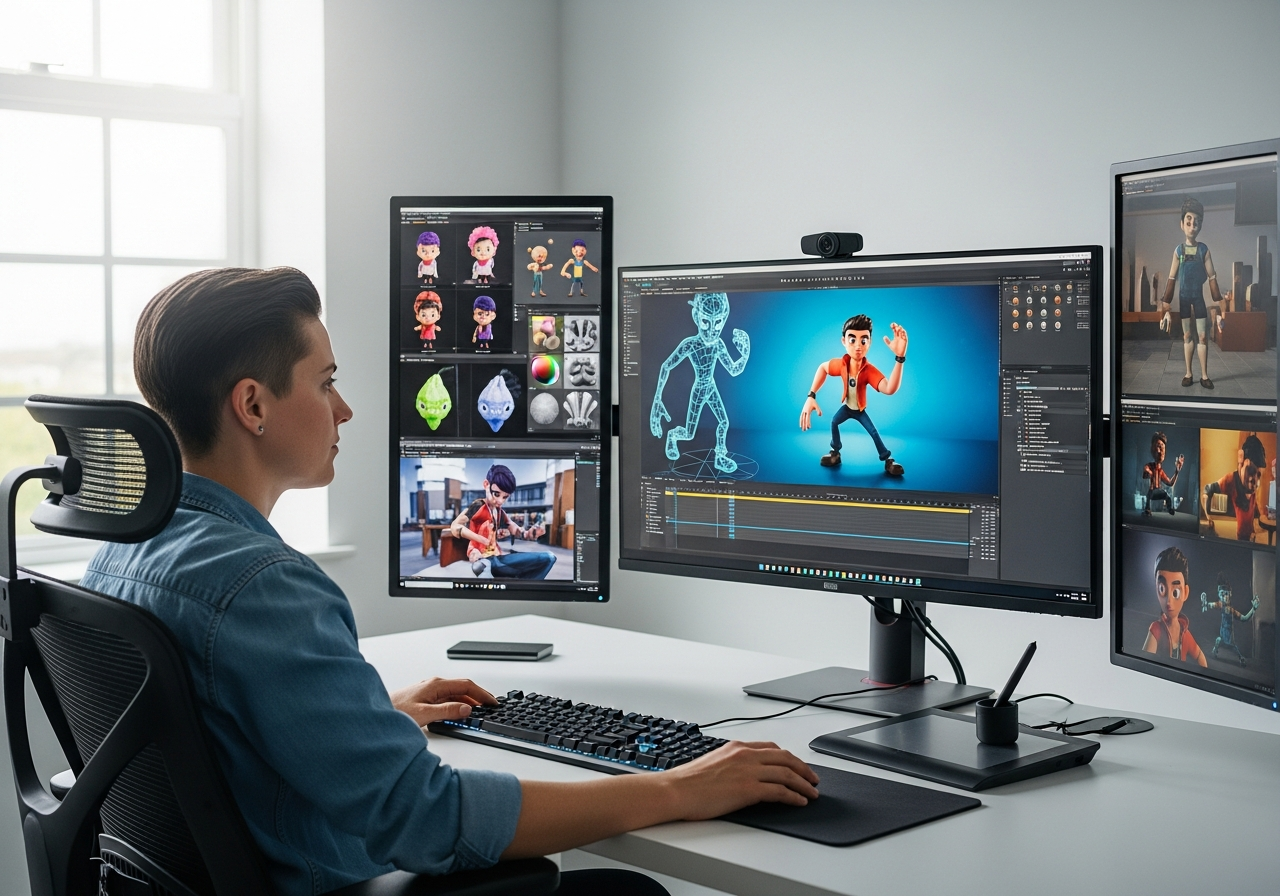
The freelance 3D animation industry in Canada has experienced unprecedented growth during the remote work boom, with skilled animators increasingly choosing independent contractor status over traditional employment. This shift has created a complex landscape where understanding labor laws becomes crucial for professional success and legal protection.
Since freelance 3D animators are generally excluded from Employment Standards Act (ESA) protections, their professional relationships are governed primarily through contractual agreements rather than standard employment legislation. Under the National Occupational Classification (NOC) 52120, multimedia artists and animators are predominantly classified as self-employed, making contract negotiation and legal compliance essential skills for career sustainability.
Freelancer Status Under Canadian Labor Law
The distinction between self-employed freelancers and employees forms the foundation of Canadian labor law as it applies to 3D animators. Self-employed individuals operate as independent businesses, maintaining control over their work methods, schedules, and client relationships, while employees work under direct supervision with predetermined schedules and company-provided resources.
Under NOC 52120, multimedia artists and animators are predominantly classified as self-employed contractors, which excludes them from standard ESA protections such as minimum wage guarantees, overtime pay, vacation entitlements, and termination notice requirements. This classification places the burden of protection on well-crafted independent contractor agreements that must address compensation, working conditions, and dispute resolution mechanisms.
The legal framework requires freelance animators to establish clear contractual relationships with each client, as these agreements serve as the primary source of rights and obligations. Unlike employees who benefit from statutory protections, freelancers must negotiate every aspect of their working relationship, from payment terms to intellectual property ownership, making contract literacy a fundamental professional skill.
Key Tests for Employee Misclassification
Canadian courts apply specific tests to determine whether a working relationship constitutes employment or independent contracting, and understanding these criteria helps 3D animators maintain their freelance status. Misclassification can result in significant legal and financial consequences for both parties, making proper categorization essential.
- Control Test: Freelancers maintain autonomy over how, when, and where they complete their work, while employees receive detailed direction and supervision
- Tools and Equipment: Independent contractors typically provide their own software licenses, hardware, and workspace, whereas employees use company-provided resources
- Profit and Loss Opportunity: Freelancers bear the financial risk of projects and can profit from efficient work, while employees receive fixed compensation regardless of project outcomes
- Integration Test: Contractors provide specialized services that complement but don’t integrate into the client’s core business operations
- Exclusivity Arrangements: True freelancers maintain the right to work for multiple clients simultaneously and build their own client base
- Intent of Parties: Written agreements that clearly establish an independent contractor relationship support freelance classification when other factors align
Implications for 3D Animators
Most 3D freelancers naturally fit the independent contractor model due to the specialized, project-based nature of animation work. Animators typically maintain their own software licenses for programs like Maya, Blender, or Cinema 4D, work from personal studios or home offices, and provide finished deliverables rather than ongoing daily services.
The creative and technical expertise required for 3D animation positions freelancers as specialized service providers rather than integrated employees, particularly when they maintain multiple client relationships and control their project workflows. This independence allows animators to develop diverse portfolios while building sustainable business practices that align with Canadian freelance regulations.
Independent Contractor Agreements Essentials
Well-structured independent contractor agreements serve as the cornerstone of legal protection for freelance 3D animators, replacing the statutory protections available to employees. These contracts must address every aspect of the working relationship, from project scope to payment terms, ensuring both parties understand their rights and obligations.
Each client engagement requires a specifically negotiated contract that reflects the unique requirements of the animation project, whether it involves character rigging, environmental modeling, or full sequence animation. Generic contracts often fail to address the technical specifications and creative processes inherent in 3D animation work, potentially leading to disputes over deliverables and quality standards.
| Clause | Description | Animator Tip |
|---|---|---|
| Scope of Work | Detailed description of deliverables, file formats, and quality standards | Specify polygon counts, texture resolutions, and render requirements |
| Payment Terms | Rate structure, milestone payments, and invoice procedures | Request 25-50% upfront for software and time investment |
| Intellectual Property | Ownership rights for original assets and final deliverables | Retain rights to custom rigs and personal asset libraries |
| Revision Policy | Number of included revisions and rates for additional changes | Limit major revisions after modeling approval phase |
| Timeline and Deadlines | Project milestones, delivery dates, and delay procedures | Build buffer time for rendering and client feedback loops |
| Termination Clause | Conditions for project cancellation and compensation for completed work | Include kill fee provisions for projects cancelled mid-stream |
| Portfolio Rights | Permission to display work samples for marketing purposes | Negotiate showcase rights even for confidential projects |
Common Pitfalls in Animation Contracts
Many freelance animators encounter recurring contractual issues that can significantly impact their income and professional relationships. Understanding these common pitfalls helps prevent disputes and ensures fair compensation for creative work.
Intellectual property disputes represent the most frequent source of conflict, particularly when clients expect to own custom rigs, scripts, or asset libraries developed during the project. Without clear IP clauses, animators may lose valuable tools they’ve invested considerable time creating.
Revision policies often favor clients excessively, leading to scope creep where minor adjustments evolve into major project changes without additional compensation. Kill fees and project cancellation terms frequently receive insufficient attention, leaving animators vulnerable when clients abandon projects after significant work has been completed.
- Undefined Intellectual Property Rights: Failing to specify ownership of custom rigs, scripts, and reusable assets can result in losing valuable proprietary tools
- Unlimited Revision Clauses: Contracts without revision limits enable scope creep, turning profitable projects into time-consuming losses
- Missing Kill Fee Provisions: Lack of cancellation compensation leaves animators unpaid for work completed before project termination
- Vague Quality Standards: Undefined technical specifications lead to disputes over acceptable deliverable quality and completion criteria
- Payment Schedule Imbalances: Back-heavy payment schedules create cash flow problems and increase collection risks for freelancers
- Inadequate Portfolio Protection: Overly restrictive confidentiality clauses prevent animators from showcasing their work for future marketing
- Missing Force Majeure Clauses: Absence of unforeseen circumstances protection can make freelancers liable for delays beyond their control
Payment and Wages for Freelancers
Freelance 3D animators operate outside traditional wage structures, with compensation typically negotiated on a project or hourly basis rather than through minimum wage protections. The median rate for Canadian 3D animators hovers around $30 per hour, though experienced specialists can command significantly higher rates for complex character animation or technical specialty work.
Income patterns for freelance animators tend to be project-based and seasonal, with busy periods alternating with slower months that require careful financial planning. Unlike salaried employees, freelancers must account for unpaid time between projects, client acquisition efforts, and the administrative overhead of running their own business when setting their rates.
Successful rate negotiation requires understanding both the market value of specific animation skills and the client’s budget constraints, with rates varying significantly based on project complexity, timeline pressure, and the animator’s specialized expertise. Many freelancers develop tiered pricing structures that reflect different service levels, from basic modeling work to complex character rigging and animation sequences.
Payment timing becomes crucial for cash flow management, with many animators requiring partial payment upfront to cover software costs and time investment before project completion. Net-30 payment terms are common in the industry, though freelancers often negotiate shorter payment periods for smaller projects or new client relationships to minimize collection risks.
Provincial Wage Benchmarks
Regional variations in freelance animation rates reflect local market conditions, cost of living differences, and the concentration of animation studios and production companies. These benchmarks provide guidance for rate setting while recognizing that individual negotiations may vary significantly based on experience and project requirements.
Alberta leads Canadian provinces with average hourly rates of $30.51, driven by strong oil and gas industry demand for technical animation and visualization services. Ontario maintains similar rates due to its concentrated entertainment industry presence, while smaller provinces often see lower average rates despite potentially less competition among freelancers.
| Province | Median Hourly | Annual Avg | Source Notes |
|---|---|---|---|
| Alberta | $30.51 | $63,460 | Government of Canada Job Bank |
| Ontario | $29.75 | $61,880 | Provincial labor statistics |
| British Columbia | $28.90 | $60,110 | Industry surveys |
| Quebec | $26.85 | $55,850 | Cultural industry data |
| Manitoba | $25.40 | $52,830 | Regional employment data |
| Saskatchewan | $24.75 | $51,480 | Provincial wage surveys |
| Nova Scotia | $23.20 | $48,260 | Atlantic region statistics |
| New Brunswick | $22.60 | $47,010 | Economic development data |
Intellectual Property Rights
Intellectual property ownership represents one of the most complex and valuable aspects of freelance 3D animation contracts, with significant implications for both immediate compensation and long-term career development. Understanding copyright principles and negotiating appropriate IP clauses can mean the difference between building a valuable asset library and repeatedly recreating similar work for different clients.
Canadian copyright law operates on a work-for-hire presumption, meaning that unless otherwise specified in contract, clients automatically acquire ownership rights to commissioned animation work. However, this default can be modified through careful contract negotiation, allowing animators to retain rights to reusable assets, custom scripts, or character rigs that extend beyond a single project’s requirements.
Portfolio usage rights require specific attention in animation contracts, as many clients impose broad confidentiality restrictions that can prevent freelancers from showcasing their best work for marketing purposes. Negotiating limited showcase rights, even for confidential projects, helps animators build their professional reputation and attract future clients while respecting legitimate client privacy concerns.
- Identify Reusable Assets: Distinguish between client-specific deliverables and reusable tools like custom rigs, scripts, or asset libraries that benefit future projects
- Negotiate Dual-Use Rights: Structure contracts to grant clients full rights to final deliverables while retaining ownership of underlying tools and methodologies
- Document Creation Process: Maintain detailed records of original asset creation to support ownership claims and demonstrate independent development
- Establish Portfolio Clauses: Secure specific rights to display work samples, even from confidential projects, with appropriate timing and disclosure limitations
- Define Derivative Works: Clarify whether clients can modify or create derivative works from delivered assets without additional compensation or credit
- Address Moral Rights: Include provisions for attribution and integrity rights that protect the animator’s professional reputation and creative vision
Protecting Your 3D Animation IP
Proactive intellectual property protection requires both legal understanding and practical documentation strategies that establish clear ownership timelines and creation records. Many IP disputes arise from inadequate documentation rather than unclear legal principles, making detailed project records essential for freelance animators.
Version control systems and timestamped file backups provide crucial evidence for establishing creation dates and development sequences when ownership questions arise. Cloud storage services with automatic versioning help maintain comprehensive project histories that support IP claims while providing backup protection for valuable digital assets.
Copyright registration, while not required for ownership, provides enhanced legal protections and damages remedies that justify the modest cost for valuable original works. Registration creates a public record of ownership and enables statutory damages in infringement cases, particularly important for character designs or proprietary animation techniques with broad commercial potential.
Taxes and Self-Employment Obligations
Freelance 3D animators face significantly more complex tax obligations than traditional employees, with requirements spanning income tax, goods and services tax, and Canada Pension Plan contributions that demand careful attention throughout the year. Unlike employees who have taxes automatically deducted from paychecks, self-employed animators must calculate and remit their own tax payments on a quarterly basis to avoid penalties and interest charges.
The goods and services tax (GST) or harmonized sales tax (HST) registration threshold of $30,000 in annual income affects most successful freelancers, requiring quarterly remittances and detailed record-keeping for all business transactions. Form T2125 becomes the central document for reporting self-employment income and expenses, with particular attention required for home office expenses, equipment depreciation, and professional development costs specific to animation work.
Quarterly tax installment payments help manage cash flow and avoid large year-end tax bills, though calculating appropriate amounts requires understanding both current year income and previous year tax liability. Many freelance animators benefit from professional accounting services to ensure compliance with complex tax regulations while maximizing legitimate business deductions.
| Obligation | Requirement | Deadline/Rate |
|---|---|---|
| Income Tax | Annual tax return filing with business income schedule | June 15 filing, April 30 payment |
| GST/HST Registration | Mandatory registration when income exceeds $30,000 | 5-15% depending on province |
| CPP Contributions | Self-employed pension contributions on net income | 10.9% on income between $3,500-$66,600 |
| Quarterly Installments | Advance tax payments when owing over $3,000 | March 15, June 15, Sept 15, Dec 15 |
| Business Registration | Provincial business name registration if using trade name | Varies by province, typically $60-$350 |
| Record Keeping | Maintain business records and receipts for six years | Ongoing requirement |
Deductions for Animators
Strategic tax planning for freelance animators involves maximizing legitimate business deductions while maintaining detailed documentation to support expense claims during potential audits. Animation-specific expenses often represent significant portions of annual income, making proper deduction claiming crucial for tax efficiency.
Home office expenses require careful calculation based on the percentage of home space used exclusively for business purposes, with utilities, rent, and maintenance costs proportionally deductible. Software subscriptions for professional animation tools like Maya, Cinema 4D, or Adobe Creative Suite qualify as fully deductible business expenses when used exclusively for client work.
- Software and License Fees: Annual subscriptions for Maya, Cinema 4D, Adobe Creative Suite, and specialized plugins are fully deductible business expenses
- Computer Hardware and Equipment: High-end graphics cards, workstations, and professional monitors qualify for capital cost allowance or immediate expensing
- Home Office Expenses: Proportional utilities, rent, insurance, and maintenance costs based on dedicated workspace percentage
- Professional Development: Online courses, workshops, conferences, and certification programs related to animation skills
- Internet and Phone Services: Business portions of high-speed internet and phone services necessary for client communication and file transfers
- Travel and Transportation: Client meetings, industry events, and equipment purchases require detailed mileage and receipt documentation
- Professional Services: Legal, accounting, and business consulting fees directly related to freelance animation work
Benefits Access
Freelance animators face limited access to employment insurance benefits due to their self-employed status, though recent federal programs have expanded coverage for certain types of independent contractors. The Special Benefits for Self-employed program allows voluntary participation for maternity, parental, sickness, and compassionate care benefits, though regular EI benefits remain unavailable.
Private insurance options become essential for income protection and health coverage, with many freelancers joining professional associations or freelancer cooperatives to access group insurance plans. Disability insurance particularly matters for animators whose income depends on their ability to use computer equipment for extended periods, as repetitive strain injuries or vision problems can significantly impact earning capacity.
Provincial Variations in Regulations
Canadian freelance regulations operate under a complex framework of federal tax law and provincial employment standards that create significant regional variations in rights and obligations. While federal income tax and GST/HST requirements remain consistent across provinces, employment classification tests and contract enforcement mechanisms can vary substantially based on provincial common law interpretations and local labor regulations.
Alberta maintains relatively less regulated freelance markets compared to provinces like Ontario or British Columbia, where stronger labor protections and more active enforcement agencies provide additional safeguards for independent contractors. These differences affect everything from contract dispute resolution procedures to the availability of provincial programs supporting self-employed workers during economic downturns or industry disruptions.
Hotspots for Freelance Animators
Regional animation industry clusters create distinct markets with varying opportunities, competition levels, and typical rate structures that influence freelance career decisions. Understanding these regional differences helps animators choose locations that align with their career goals and specialization areas.
Ontario, British Columbia, and Quebec represent the strongest markets for freelance animation work, driven by established film industries, gaming companies, and advertising agencies that regularly require specialized 3D animation services. These provinces offer the most consistent project flow and highest average rates, though competition among freelancers is correspondingly intense.
| Province | Job Outlook | Freelance Notes | Median Wage |
|---|---|---|---|
| Ontario | Excellent | Strong film/TV industry, high competition | $29.75/hr |
| British Columbia | Very Good | Gaming industry hub, tech sector demand | $28.90/hr |
| Quebec | Good | Growing animation sector, tax incentives | $26.85/hr |
| Alberta | Moderate | Energy sector visualization, less regulation | $30.51/hr |
| Manitoba | Fair | Emerging market, lower cost of living | $25.40/hr |
| Saskatchewan | Limited | Rural market, specialized niches | $24.75/hr |
| Nova Scotia | Emerging | Growing tech sector, remote work friendly | $23.20/hr |
| New Brunswick | Limited | Small market, government contracts | $22.60/hr |
Disputes and Enforcement
Contract disputes represent an inevitable reality for freelance 3D animators, making dispute prevention and resolution planning essential components of every client relationship. Effective dispute management begins during contract negotiation with clear arbitration clauses, defined quality standards, and structured communication protocols that reduce misunderstandings before they escalate into legal conflicts.
Non-payment issues plague the freelance animation industry, requiring proactive collection strategies and legal remedies that balance relationship preservation with income protection. Alternative dispute resolution mechanisms often prove more cost-effective than traditional litigation for resolving payment disputes, scope disagreements, and intellectual property conflicts common in creative industries.
Small claims courts provide accessible venues for collecting unpaid invoices under provincial monetary limits, typically ranging from $25,000 to $50,000 depending on jurisdiction. These procedures require detailed documentation of contract terms, delivered work, and communication records that support payment claims while keeping legal costs proportional to disputed amounts.
Professional mediation services specializing in creative industry disputes offer confidential resolution processes that preserve ongoing client relationships while addressing specific project conflicts. Many animation industry associations provide member access to mediation services and standardized contract templates that reduce dispute likelihood through clear, tested agreement language.
- Document Everything: Maintain detailed records of project communications, revision requests, and approval timelines to support dispute resolution efforts
- Include Arbitration Clauses: Specify binding arbitration procedures in contracts to avoid expensive court proceedings for most disputes
- Establish Clear Approval Processes: Define milestone approval requirements and revision limits to prevent scope creep and payment disputes
- Use Progressive Collection Procedures: Implement systematic follow-up schedules for overdue payments before pursuing legal remedies
- Consider Professional Associations: Join industry organizations that provide dispute resolution services and standardized contract resources
- Maintain Professional Insurance: Secure errors and omissions coverage to protect against claims related to technical problems or missed deadlines
Non-Compete and NDAs
Non-compete agreements in freelance animation contracts must meet strict reasonableness tests under Canadian law, balancing legitimate client interests against freelancers’ rights to earn livelihood in their chosen profession. Courts typically scrutinize these clauses for geographic scope, duration, and breadth of restricted activities, often striking down overly broad restrictions that prevent animators from working in their field.
Effective non-disclosure agreements protect client confidentiality without unnecessarily restricting freelancer portfolio development and marketing activities. Well-drafted NDAs specify exactly what information requires protection, distinguish between truly confidential material and general industry knowledge, and include reasonable time limits that recognize the fast-paced evolution of animation technology and techniques.
Non-solicitation clauses offer a middle ground between comprehensive non-compete restrictions and unlimited freelancer mobility, preventing direct recruitment of client employees or customers while preserving the animator’s right to pursue similar work with different organizations. These agreements typically prove more enforceable than broad non-compete clauses while addressing legitimate client concerns about relationship disruption.
Best Practices for 3D Animator Freelancers
Successful freelance animation careers require systematic approaches to contract management, client relationship development, and legal compliance that extend beyond technical animation skills. Professional practices that integrate legal awareness with business development create sustainable careers while minimizing dispute risks and maximizing income potential.
Each client contract demands individual review and customization rather than relying on generic templates that fail to address project-specific requirements and industry nuances. Professional associations like ACTRA provide valuable contract guidance and dispute resolution services that help freelancers navigate complex client relationships while maintaining focus on creative work rather than legal administration.
| Practice | Benefit | Legal Tie-In |
|---|---|---|
| Individual Contract Review | Customized protection for each project’s unique requirements | Ensures compliance with NOC 52120 independence standards |
| Professional Association Membership | Access to standardized contracts and dispute resolution | ACTRA provides tested contract templates and mediation |
| Portfolio Rights Documentation | Marketing materials for future client acquisition | Preserves showcase rights despite IP transfer agreements |
| Systematic Tax Planning | Maximizes deductions while ensuring compliance | Meets self-employment obligations under CRA guidelines |
| Clear Quality Standards | Reduces revision disputes and scope creep | Supports contract enforcement in dispute situations |
| Progressive Payment Structure | Improves cash flow and reduces collection risks | Facilitates small claims recovery for unpaid amounts |
| Professional Insurance Coverage | Protection against liability and income loss | Complements limited self-employed benefit access |
Resources and Next Steps
Building a comprehensive understanding of Canadian freelance laws requires ongoing education through official government resources, industry associations, and professional development opportunities specific to creative industries. These resources provide current information about regulatory changes, tax updates, and industry best practices that affect freelance animation careers.
Implementation of proper legal frameworks should proceed systematically, beginning with fundamental contract templates and tax compliance systems before advancing to sophisticated intellectual property strategies and dispute prevention mechanisms that support long-term career growth.
- Canada Revenue Agency Self-Employment Guide: Essential resource for tax obligations, deductions, and reporting requirements specific to freelance animators
- Provincial Labour Relations Boards: Primary sources for employment classification guidance and contractor rights in each province
- Canadian Artists and Producers Professional Relations Tribunal: Industry-specific guidance for creative professional contracts and dispute resolution
- Legal Aid Clinics and Business Development Centers: Low-cost legal advice and contract review services for small business operators
- Professional Animation Associations: Industry networking, standardized contracts, and continuing education about legal developments affecting freelancers